
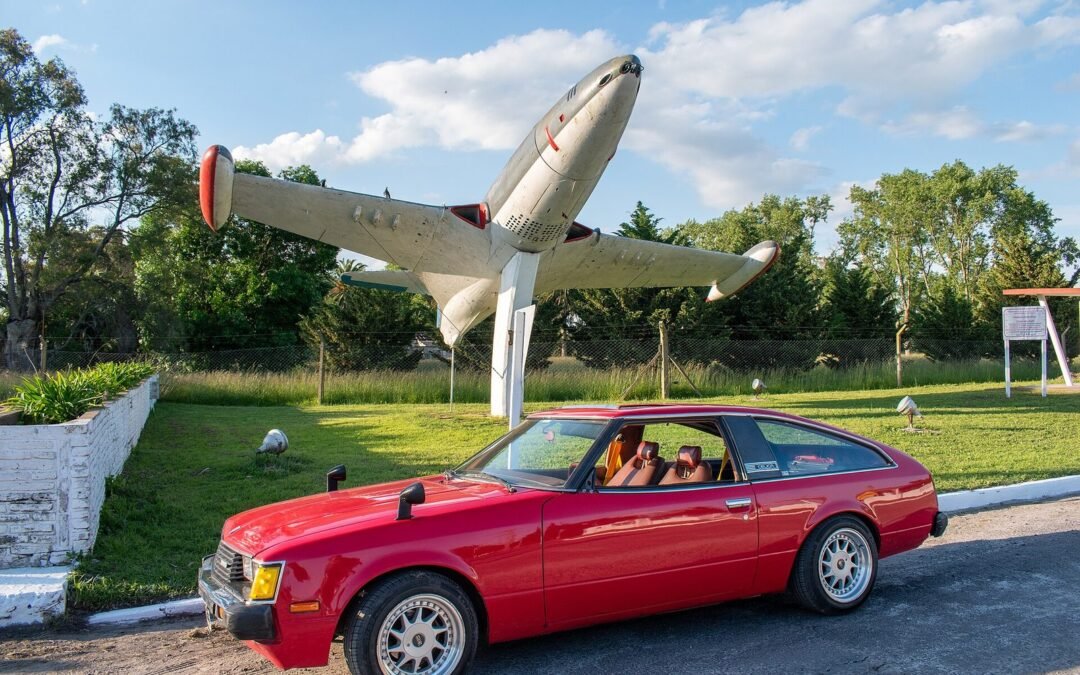
For almost eight years the Toyota Supra was not a model of its own but a Toyota Celica: a liftback stretched to take a six-cylinder engine. Here is what set it apart from the four-cylinder Celica, generation by generation, with Toyota’s own figures from its 75-year vehicle history and the original Japanese catalogues, and how the two cars went their separate ways in 1986.
1978: a Celica stretched for a six
Toyota built the car to take on the Z car (the Fairlady Z) in the US. It took the Celica liftback, made the wheelbase 130 mm and the body 270 mm longer and fitted a six-cylinder engine.1 Toyota UK gives its chassis code as A40.2 The Celica XX went on sale in Japan on 13 April 1978.1
Of those 270 mm, 130 went into the wheelbase and 140 into the overhangs (our calculation from Toyota’s figures). Toyota lists the long nose, a grille with a T-bar motif and horizontal rear lamps as its styling marks. Both engines came from the Crown: the 2.0-litre M-EU and the 2.6-litre 4M-EU, inline sixes with a single overhead camshaft. The top G grade could be ordered with Connolly leather seats. In August 1980 a 2.8-litre 5M-EU replaced the 2.6, and a semi-trailing-arm rear suspension replaced the rigid axle.1 The 1978 catalogue rates the sixes at 125 and 140 PS and lists electronic fuel injection on both.8
Toyota built the Celica XX at its Tahara plant; the 2nd-generation Celica came from Tsutsumi.15 In Toyota’s own family tree the Celica XX is drawn as a branch of the 2nd-generation Celica Liftback.9 The four-cylinder car of those years is on our 2nd-generation page.
1981: the second Celica XX
The second Celica XX was released on 2 July 1981, the same day as the 3rd-generation Celica, and again used the Celica liftback as its base; Toyota names its pop-up headlamps and wedge shape as the main design features.34 Toyota UK adds that the body was the same as the regular Celica’s from the B-pillar back, and that a long wheelbase, a stretched nose, flared wheel arches and independent rear suspension set it apart.2
At launch there were two inline sixes: the 2.0-litre 1G-EU with 125 PS and the 2.8-litre 5M-GEU, now with two overhead camshafts and 170 PS.310 The Soarer, launched in February 1981, was a sister car with the same six-cylinder engines; Toyota calls the Soarer the luxury car and the Celica XX the sportier one. In the summer of 1983 the 5M-GEU gained power and two engines joined: the M-TEU turbo and the 1G-GEU twin-cam with four valves per cylinder. Some grades offered a digital instrument panel and Navicom, which Toyota calls the world’s first car navigation system: a microchip worked out the direction and distance to the destination and showed them as the car moved.3
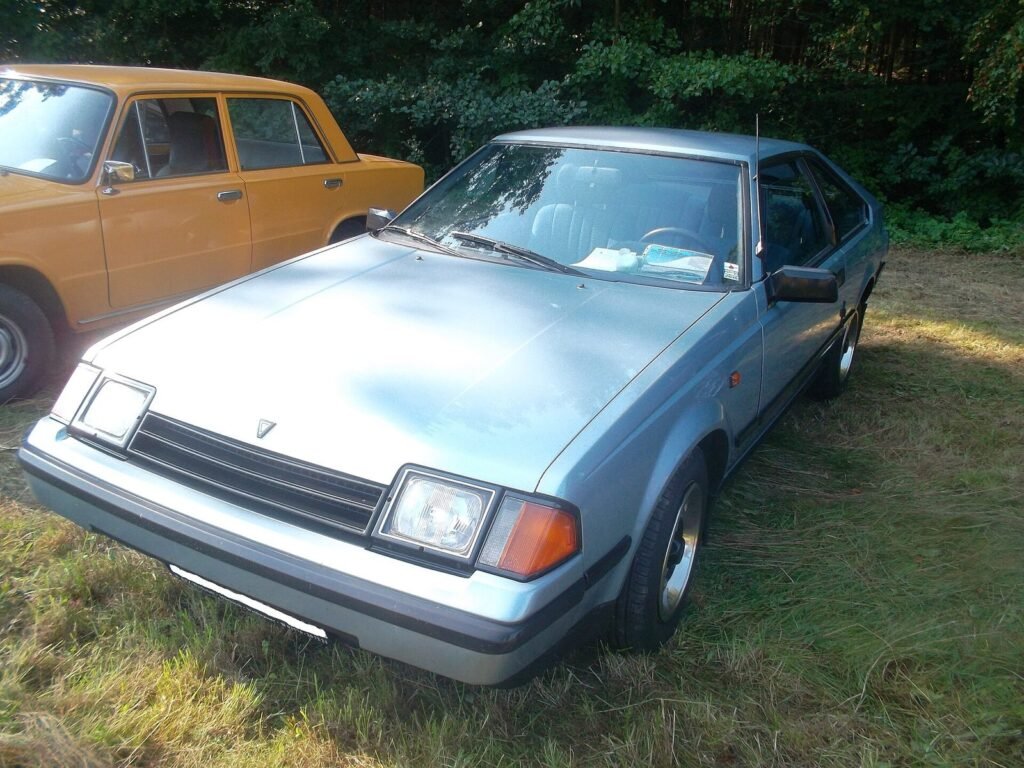
The four-cylinder 1981 car has its own 3rd-generation page.
Celica and Celica XX in figures
The table puts the top Celica Liftback of each generation at launch next to the top six-cylinder model, with Japanese-market figures from Toyota. Lengths, wheelbases, widths and heights are in millimetres, weights in kilograms; the differences are our calculation.
| Japanese model | Length | Wheelbase | Width | Height | Weight | Power |
|---|---|---|---|---|---|---|
| Celica Liftback 2000GT (RA40), 1977511 | 4,410 | 2,500 | 1,640 | 1,300 | 1,055 | 130 PS |
| Celica XX 2600G (MA46), 197818 | 4,600 | 2,630 | 1,650 | 1,310 | 1,180 | 140 PS |
| Difference | +190 | +130 | +10 | +10 | +125 | +10 PS |
| Celica Liftback 2000GT (RA63), 19814 | 4,450 | 2,500 | 1,665 | 1,320 | 1,165 | 135 PS |
| Celica XX 2800GT (MA61), 1981310 | 4,660 | 2,615 | 1,685 | 1,315 | 1,235 | 170 PS |
| Difference | +210 | +115 | +20 | −5 | +70 | +35 PS |
| Celica Liftback 2000GT-R (ST162), 198561213 | 4,365 | 2,525 | 1,690 | 1,295 | 1,120 | 140 PS |
| Supra 3.0GT Turbo (MA70), 1986714 | 4,620 | 2,595 | 1,690 | 1,310 | 1,520 | 230 PS |
| Difference | +255 | +70 | 0 | +15 | +400 | +90 PS |
How much bigger than the Celica, in mm
LengthWheelbase
Why 190 mm and not Toyota’s 270? The 1977 catalogue lists the Celica Liftback 2000GT at 4,410 mm but most other versions at 4,330 mm; Toyota’s figure matches those.11 In 1981 the gap was 210 mm, 115 of it in the wheelbase. If the body was the same from the B-pillar back, as Toyota UK says, the other 95 mm sat ahead of the front wheels (our calculation).2 In 1986 the length gap grew again, but the Supra no longer shared the Celica’s base; it was exactly as wide as the Celica.376
| Launch | Celica (four-cylinder) | Celica XX / Supra (six-cylinder) |
|---|---|---|
| 1977–78 | RA40: 18R-GU, 1,968 cc inline four, DOHC. Tsutsumi plant5 | MA46: 4M-EU, 2,563 cc inline six, OHC; MA45: M-EU, 1,988 cc six. Tahara plant1 |
| 1981 | RA63: 18R-GEU, 1,968 cc inline four, DOHC. Tsutsumi plant4 | MA61: 5M-GEU, 2,759 cc inline six, DOHC; GA61: 1G-EU, 1,988 cc six, OHC. Tahara plant3 |
| 1985–86 | ST162: 3S-GELU, 1,998 cc inline four, DOHC 16-valve, front-wheel drive. Tahara plant6 | MA70: 7M-GTEU, 2,954 cc inline six, DOHC turbo; GA70: 1G-GTEU, 1G-GEU and 1G-EU, 1,988 cc. Rear-wheel drive. Tahara plant7142 |
In these model codes the first letter follows the engine family: R for the 18R four, M for the M, 4M, 5M and 7M sixes, G for the 1G six and S for the 3S four (our reading of Toyota’s tables).541367
About the power figures. For 1977 to 1981 they are JIS ratings of the time, as in Toyota’s catalogues;11810 the 1986 Supra catalogue gives net ratings and says net figures are about 15% lower than gross for petrol cars.14 For the 1985 Celica 2000GT-R Toyota’s figures differ: the 1985 launch catalogue gives 160 PS gross, Toyota’s history page for the 1985 Celica 136 PS net and its page for the 1987 convertible 140 PS net for the same model type. We show 140 PS, as in our comparison tool.13612 The Supra 3.0GT Turbo came only with the ECT-S automatic.14
Compare the 1977, 1981 and 1985 Celica Liftbacks side by side in our comparison tool.
One car, three names
In Japan the car was always the Celica XX; Toyota says “XX” stands for an unknown quantity.1 Toyota’s history page says the first generation was marketed as the Supra in North America,1 but Toyota’s US newsroom calls it the Toyota Celica Supra, A-40, and lists it for the model years 1979 to 1981.1516
The second generation was sold as the Celica Supra in all export markets, Toyota UK says. It reached Europe for the first time in August 1982, and the UK received only 100 cars a month.2 In Toyota USA’s words, the Supra was redesigned in 1982 “along with the entire Celica line-up”.16
The name Supra comes from the Latin supra, “above” or “transcending”, according to Toyota. In 1986 the car took that export name in Japan too.7
1985–86: the Celica goes front-wheel drive, the Supra goes alone
The 4th-generation Celica, released on 20 August 1985, replaced rear-wheel drive with a transverse front engine and front-wheel drive, shared its platform with the front-drive Corona and Carina and at launch came only as a hatchback coupé.6 Toyota UK says production of the A60 Celica Supra ended in December 1985,2 while Toyota’s family-tree data runs the Celica XX line to February 1986.9
On 6 February 1986 the Celica XX dropped the Celica name and became an independent model; in Japan it took the name Supra, which it had used abroad. It had double-wishbone suspension on all four wheels, which Toyota had last used on the 2000GT, and four inline sixes, topped by the 3.0-litre 7M-GTEU turbo with 230 PS net.714 Toyota says this car no longer used the Celica as its base, and its family tree starts the 1986 Supra as a new line with no parent.39 At 4,620 mm it was 40 mm shorter than the 1981 Celica XX 2800GT (our calculation);73 Toyota UK calls it “fractionally shorter” than the outgoing Celica Supra.2 UK sales began in July 1986.2 The front-drive Celica, and the GT-Four that followed it, are on our 4th-generation page.
Timeline
| Date | What happened |
|---|---|
| 22 Aug 1977 | 2nd-generation Celica released in Japan5 |
| 13 Apr 1978 | Celica XX released in Japan; Toyota UK dates the Supra name to the same month12 |
| 1979–1981 | US model years of the first Celica Supra15 |
| Aug 1980 | 2.8-litre 5M-EU replaces the 2.6; semi-trailing-arm rear suspension1 |
| 2 Jul 1981 | 3rd-generation Celica and 2nd-generation Celica XX released on the same day43 |
| Aug 1982 | Celica Supra on sale in Europe for the first time2 |
| Summer 1983 | More power for the 5M-GEU; M-TEU turbo and 1G-GEU twin-cam added3 |
| 20 Aug 1985 | 4th-generation Celica: transverse engine, front-wheel drive6 |
| Dec 1985 / Feb 1986 | End of the second Celica XX / Celica Supra (sources differ)29 |
| 6 Feb 1986 | Supra (A70) released in Japan without the Celica name7 |
| Jul 1986 | UK sales of the Supra begin2 |
Frequently asked questions
Is the Celica Supra a Celica or a Supra?
Both. From 1978 to 1986 Toyota’s six-cylinder grand tourer was built on the Celica liftback with a longer wheelbase and nose, sold as the Celica XX in Japan and as the Celica Supra abroad. In February 1986 it became the separate Supra (A70).
What does XX mean in Celica XX?
Toyota says “XX” stands for an unknown quantity. The export name Supra comes from the Latin supra, “above” or “transcending”.
How much longer was the Celica XX than the Celica?
Toyota says the first Celica XX gained 130 mm of wheelbase and 270 mm of length over the Celica liftback. In 1981 the 2800GT was 210 mm longer than the Celica Liftback 2000GT, 115 mm of it in the wheelbase.
When did the Supra split from the Celica?
The Supra (A70) went on sale in Japan on 6 February 1986 as a separate rear-wheel-drive model. The Celica had moved to front-wheel drive with its 4th generation in August 1985.
Sources
- Toyota: 75 Years Vehicle Lineage, Celica XX, 1st generation (1978) (checked 22 October 2026)
- Toyota UK Magazine: “History of the Toyota Supra”, Joe Clifford, 19 October 2020, updated 6 July 2026 (checked 22 October 2026)
- Toyota: 75 Years Vehicle Lineage, Celica XX, 2nd generation (1981) (checked 22 October 2026)
- Toyota: 75 Years Vehicle Lineage, Celica Liftback, 3rd generation (1981) (checked 22 October 2026)
- Toyota: 75 Years Vehicle Lineage, Celica Liftback, 2nd generation (1977) (checked 22 October 2026)
- Toyota: 75 Years Vehicle Lineage, Celica Liftback, 4th generation (1985) (checked 22 October 2026)
- Toyota: 75 Years Vehicle Lineage, Supra, 1st generation in Japan (1986) (checked 22 October 2026)
- Toyota: original Celica XX catalogue, 1978, specification table p. 19 (digitised by Toyota, 75 Years; Japanese) (checked 22 October 2026)
- Toyota: 75 Years Vehicle Lineage, family-tree data file (family_tree.js; Celica XX, Celica Liftback and Supra entries) (checked 22 October 2026)
- Toyota: original Celica XX catalogue, 1981, specification table p. 25 (digitised by Toyota, 75 Years; Japanese) (checked 22 October 2026)
- Toyota: original Celica catalogue, 1977, specification table p. 25 (digitised by Toyota, 75 Years; Japanese) (checked 22 October 2026)
- Toyota: 75 Years Vehicle Lineage, Celica Convertible, 4th generation (1987), GT-R column (checked 22 October 2026)
- Toyota: original Celica Liftback catalogue, 1985, specification table p. 29 (digitised by Toyota, 75 Years; Japanese) (checked 22 October 2026)
- Toyota: original Supra catalogue, 1986, specification table p. 33 (digitised by Toyota, 75 Years; Japanese) (checked 22 October 2026)
- Toyota USA Newsroom: photo album “1979 – 1981 Toyota Celica Supra [First (1st) Generation]” (updated 29 April 2019) (checked 22 October 2026)
- Toyota USA Newsroom: “The Supra Lineage”, 10 July 2019 (checked 22 October 2026)
Differences in size, weight and power and the time spans: our own calculations from Toyota’s figures. Catalogue figures read from Toyota’s digitised Japanese catalogues. Top photo: BugWarp, CC BY 4.0, via Wikimedia Commons, cropped. Spotted a mistake? Write to hello@liftbacklegends.com.