
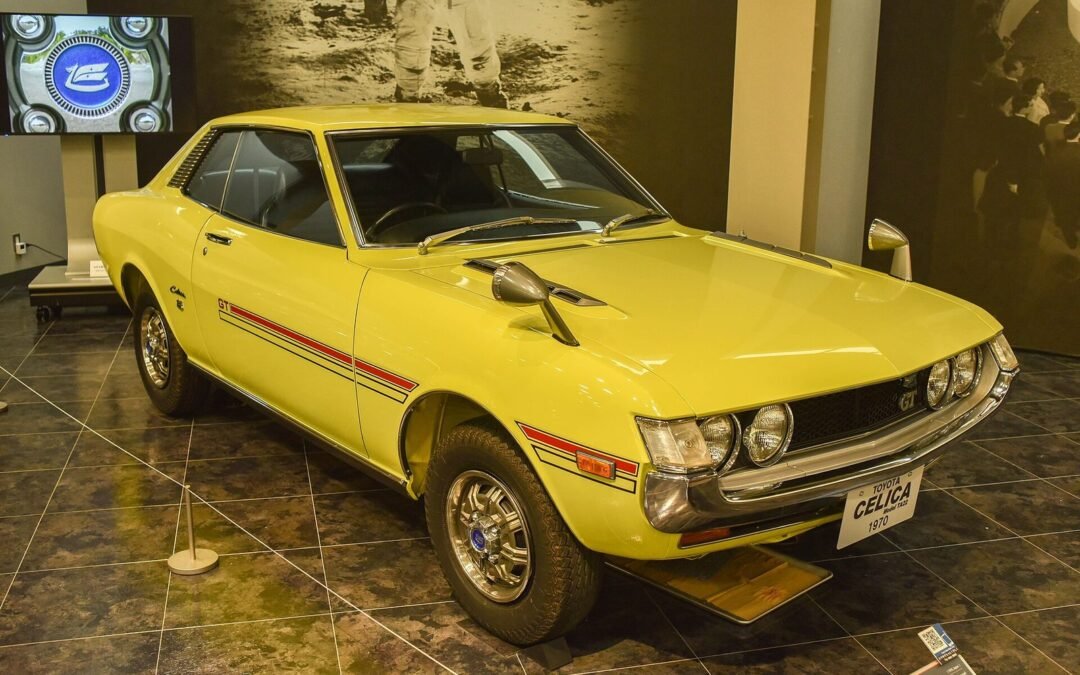
The Toyota Celica’s look came from two places. The first Celica grew out of a sketch from a design group that Toyota had only just set up in Japan.1 From 1977 Toyota’s California studio Calty took part: it designed the body of the second generation,2 and it styled the XYR concept of 1999, the preview of the last Celica.34
Celica design timeline
Dates are Toyota’s launch dates in Japan. “No data” means that none of our sources names the studio or the designers; Toyota’s design archive or Japanese design magazines of the time would be the place to look.
| When | What | Who shaped it, design notes |
|---|---|---|
| 1969 | EX-I show car, Tokyo Motor Show | A preview, built when the production design was almost settled51 |
| 1 Dec 1970 | Celica coupé on sale in Japan | Sketch from Toyota’s new advance design group, refined by a production design team101 |
| 1971 | SV-1 prototype, Tokyo Motor Show | The basis of the Liftback6 |
| 6 Apr 1973 | Celica Liftback | Three-door 2+2 with fastback styling and a large tailgate6 |
| 2 Oct 1973 | Calty opens in El Segundo, California | Toyota’s design studio in the US7 |
| 22 Aug 1977 | 2nd generation | Body design by Calty, its first production design28 |
| 2 Jul 1981 | 3rd generation | Wedge shape, “rise-up” headlamps11; studio: no data |
| 20 Aug 1985 | 4th generation | Hatchback coupé only, drag coefficient 0.3112; studio: no data |
| 6 Sep 1989 | 5th generation | Curved lines and surfaces; Calty made ceramic-clay models for a proposal138 |
| 8 Oct 1993 | 6th generation | Hundreds of proposals; no pop-up headlamps414; studio: no data |
| Jan 1999 | XYR concept, Detroit show | Styled by Calty in Newport Beach3 |
| 20 Sep 1999 | 7th generation | Virtually indistinguishable from the XYR4; WardsAuto says Calty helped, Toyota names no studio15916 |
| Jan 2000 | Convertible concept, Los Angeles | Developed by Calty; never built174 |
1970: a sketch from Toyota’s advance group
Toyota calls the first Celica Japan’s first “specialty car”: affordable and sporty, sharing its platform with a sedan, here the new Carina, but with styling and a name clearly its own.10 Toyota UK’s magazine describes the styling as inspired by American pony cars.4 Unusually, the design came before the specification: according to the Japanese magazine Motor-Fan, it went to an advance group that Toyota’s design department had only just formed, and of the group’s sketches the one chosen looked, in Motor-Fan’s view, like nothing else.1
A production design team, led by a designer who later headed Toyota’s Tokyo Design Center, built a rival full-size model. The advance group’s design won, and the production team then refined it for production, with the author of the sketch advising. The production car got four round headlamps where the early sketches seem to show two non-round ones.1 The EX-I shown at the 1969 Tokyo Motor Show was built when the production design was almost settled, so Motor-Fan reads it as a preview, not as the concept that led to the car.51
1973: the SV-1 becomes the Liftback
The second body style also started as a show car. Toyota based the Celica Liftback, a three-door 2+2 with fastback styling, on the SV-1 prototype from the 1971 Tokyo Motor Show and launched it in April 1973. The large tailgate gave it its name.6 What makes a liftback is in our glossary; the last Celica was sold only as one.94
Calty: Toyota’s studio in California
Calty Design Research opened on 2 October 1973 in El Segundo, California.7 Toyota’s US newsroom credits the idea to Shoichiro and Eiji Toyoda; in 1978 the studio moved down the coast to Newport Beach.18 The name blends California and Toyota;7 a later release adds Ya-chioda Sangyo, a trading company that then held 20% of the studio.8
Its first production design was the second-generation Celica. Toyota’s history says plainly that “the body design was undertaken by Calty Design Research” and names a low beltline, wide glass areas and, on the liftback, broad B-pillars among its features.2 The car was longer and wider than the first Celica;4 it won Motor Trend’s Import Car of the Year award for 1978.8 In August 1979 a facelift replaced the four round headlamps with rectangular ones.2 More facts are on our 2nd-generation page.
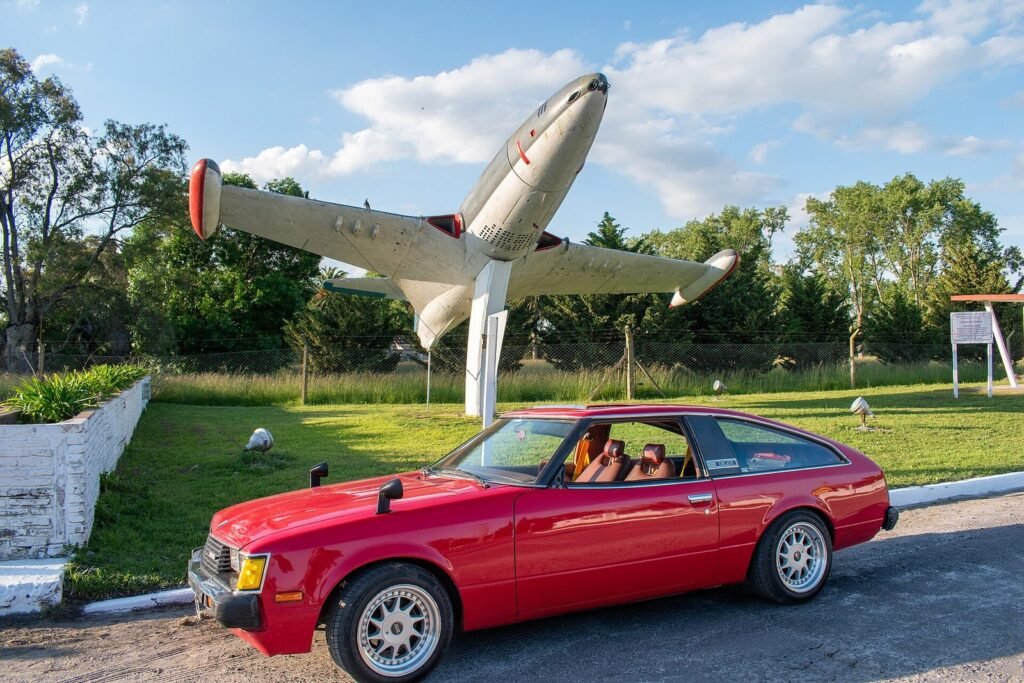
1981–1993: wedges, curves and hundreds of proposals
For the 1981, 1985 and 1993 cars, none of our sources names a studio (no data). The 1981 car was a wedge with sharp contours and flat surfaces; its semi-retractable “rise-up” headlamps sat flush with the body when closed, and from August 1983 they retracted fully.11 The 1985 car, the first with front-wheel drive, came only as a hatchback coupé with a drag coefficient of 0.31;12 Toyota GB calls it a clean-sheet design.4
Toyota’s US newsroom links Calty to the 1989 car: it lists a “1989 Celica” among the cars Calty designed or had a hand in, influenced by experiments with plaster balloon shapes and ceramic clay;7 a later release says designers at a Laguna Beach studio made small ceramic-clay models for the fifth-generation proposal, without saying how much of it reached production.8 Toyota’s history speaks of curved lines and surfaces.13 A body 55 mm wider followed in August 1990 for the export GT-Four.4
Work on the sixth generation began in spring 1990. Toyota GB says hundreds of proposals were judged with the aim of a more distinctive face; the result borrowed styling cues from the new fourth-generation Supra and was the first Celica in many years without pop-up headlamps.4 At 1,750 mm wide, it moved the Celica into Japan’s “3 number” vehicle category.14
1999: the XYR and the last Celica
At the Detroit show in January 1999 Toyota unveiled the XYR, a front-wheel-drive coupé “styled by Toyota’s CALTY Design Centre in Newport Beach”, aimed at young buyers.3 Toyota GB later wrote that the production Celica, launched that September, was virtually indistinguishable from the concept.4 The figures agree:
| XYR concept | Production Celica | |
|---|---|---|
| Engine | 1.8-litre VVTL-i, 1,795 cc3 | 2ZZ-GE, 1,795 cc (SS-II)9 |
| Power | 180 hp (SAE) at 7,600 rpm3 | 190 PS at 7,600 rpm (Japan)9; 180 hp (US GT-S)19 |
| Length | 4,333 mm (170.6 in) | 4,335 mm9 |
| Width | 1,737 mm (68.4 in) | 1,735 mm |
| Height | 1,306 mm (51.4 in) | 1,305 mm |
| Wheelbase | 2,601 mm (102.4 in); the text says 2,590 mm | 2,600 mm |
| Kerb weight | 1,140 kg | 1,120 kg (SS-II)9 |
| Automatic | 4-speed with E-Shift3 | 4-speed, shifts from the steering wheel (2ZZ-GE)16 |
Toyota GB gave the XYR’s dimensions in inches; the millimetres are our conversion. Its text gives a 2,590 mm wheelbase, its specification table 102.4 in; we show both.
Who styled the production car is less clear: Toyota’s history page and launch release name no studio;916 WardsAuto wrote in 1999 that Calty helped the Celica take on a sharper, more aggressive stance.15 Toyota’s design points were a long wheelbase with short overhangs, a “one-motion” silhouette, vertically elongated headlamps and a bonnet air intake.16 Our comparison sets the last Celica against the first Liftback; key data are on the 7th-generation page.
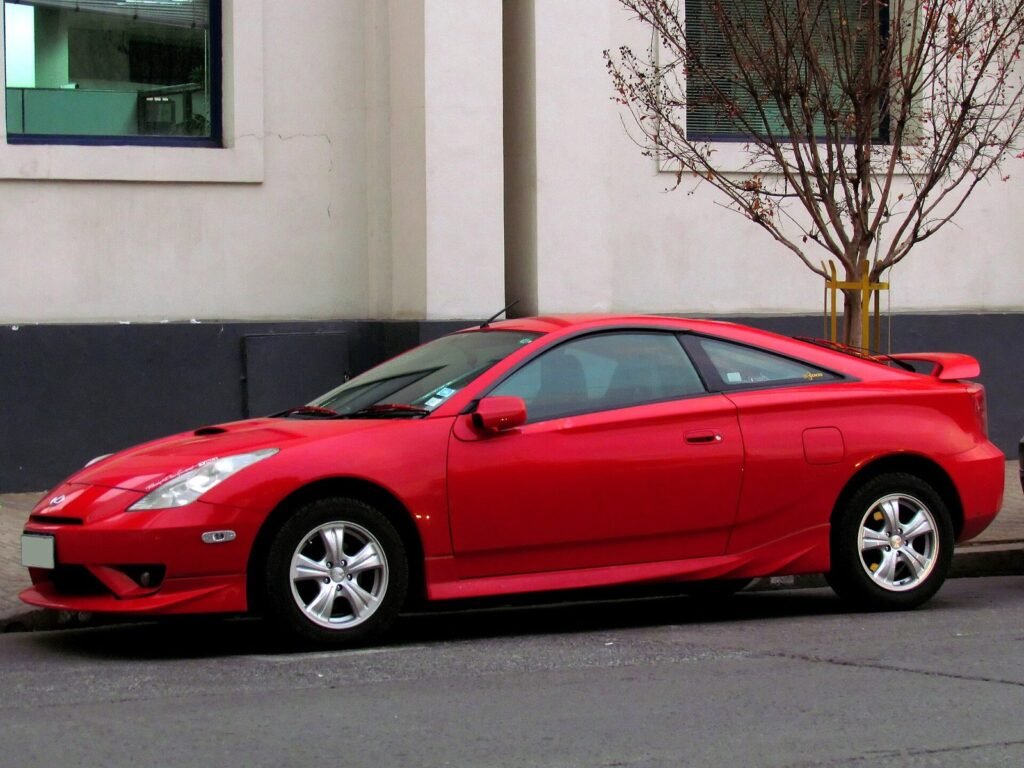
Calty also developed a Celica that never reached production: a convertible concept for the Los Angeles Auto Show in January 2000, with a soft top folding under a hard tonneau cover.17 The seventh generation stayed a coupé only, with no convertible or four-wheel-drive version,4 until production ended in April 2006.9
The proportions in numbers
Toyota’s history pages give the dimensions of every generation. Subtract the wheelbase from the overall length and what is left is the body ahead of the front wheels and behind the rear ones.
Overhangs, front and rear together (length minus wheelbase)
The overhangs grew with the second and third generations and peaked at 1,950 mm on the 1981 Liftback; the 1999 car brought them back to 1,735 mm, 5 mm less than the 1970 coupé, on a wheelbase 175 mm longer.10119 WardsAuto called it shorter than past models, with a longer wheelbase and much shorter overhangs;15 in Toyota’s figures it is shorter than every Celica from 1977 to 1993, not than the first generation.2121314 Width grew from 1,600 mm in 1970 to 1,750 mm in 1993; the 1999 car is 1,735 mm wide.10149
Frequently asked questions
Who designed the first Toyota Celica?
Its shape grew from a sketch made in Toyota’s newly formed advance design group in Japan; a production design team then refined it before the Celica went on sale on 1 December 1970.
What is Calty?
Calty Design Research is Toyota’s design studio in California, opened on 2 October 1973 in El Segundo and based in Newport Beach since 1978. Its first production design was the second-generation Celica.
Which concept car previewed the last Celica?
The XYR, styled by Calty and shown at the Detroit show in January 1999. In Toyota GB’s specification table its length, width, height and wheelbase are within 2 mm of the production car’s.
Where did the Celica Liftback come from?
Toyota based it on the SV-1 prototype shown at the 1971 Tokyo Motor Show and launched it in April 1973.
Sources
- Motor-Fan: the first Celica’s exterior design, series “Jidai no meisha tanbō” No. 2-6, Hisashi Yamaguchi, 1 May 2025 (in Japanese) (checked 22 October 2026)
- Toyota, 75 Years Vehicle Lineage: Celica Liftback, 2nd generation (1977) (checked 22 October 2026)
- Toyota (GB) media site: “Toyota Unveils Lightweight High Performance XYR Sports Coupe Concept”, 6 January 1999 (checked 22 October 2026)
- Toyota UK Magazine: “Toyota Celica history – a groundbreaking sports car”, Joe Clifford, 19 August 2026 (checked 22 October 2026)
- Motor-Fan: the first Celica, overview, series “Jidai no meisha tanbō” No. 2, Hisashi Yamaguchi, 26 April 2025 (in Japanese) (checked 22 October 2026)
- Toyota, 75 Years Vehicle Lineage: Celica Liftback, 1st generation (1973) (checked 22 October 2026)
- Toyota newsroom (USA): “Toyota’s Calty Design Research Celebrates Its 40th Year and a Rich Sports Car Design Heritage”, 13 January 2014 (checked 22 October 2026)
- Toyota newsroom (USA): “Toyota’s CALTY Design Research: 50 Years of Design and Innovation”, 18 October 2023 (checked 22 October 2026)
- Toyota, 75 Years Vehicle Lineage: Celica Liftback, 7th generation (1999) (checked 22 October 2026)
- Toyota, 75 Years Vehicle Lineage: Celica, 1st generation (1970) (checked 22 October 2026)
- Toyota, 75 Years Vehicle Lineage: Celica Liftback, 3rd generation (1981) (checked 22 October 2026)
- Toyota, 75 Years Vehicle Lineage: Celica Liftback, 4th generation (1985) (checked 22 October 2026)
- Toyota, 75 Years Vehicle Lineage: Celica Liftback, 5th generation (1989) (checked 22 October 2026)
- Toyota, 75 Years Vehicle Lineage: Celica Liftback, 6th generation (1993) (checked 22 October 2026)
- WardsAuto (archive): “Toyota Wants to Lure Boomer Babies”, Barbara McClellan, 1 September 1999 (checked 22 October 2026)
- Toyota Motor Corporation: “Toyota Unleashes a Celica Sensation”, 20 September 1999 (checked 22 October 2026)
- Toyota (GB) media site: “California Dreamin’ 2000” (Celica convertible concept, Los Angeles Auto Show), 20 January 2000 (checked 22 October 2026)
- Toyota newsroom (USA): “CALTY Design Research Celebrates 50 Years of Toyota Innovation and Creativity in the U.S.”, 5 October 2023 (checked 22 October 2026)
- Consumer Guide Auto: “2000-05 Toyota Celica”, Tom Appel, 30 July 2014 (checked 22 October 2026)
Inch-to-millimetre conversions (1 in = 25.4 mm), the differences between concept and production car and the overhangs (length minus wheelbase): our own calculations from Toyota’s figures. Japanese titles romanised by us. Top photo: Coolalabright, CC BY 4.0, via Wikimedia Commons. Spotted a mistake? Write to hello@liftbacklegends.com.